

Report: Canada's Cannabis Sector is Mainstream
Seven years after legalization, the cannabis industry has fully integrated into Canadian society, moving from niche to mainstream consumer choice according to a new report. A national survey by Abacus Data reveals that not only is use widespread, but Canadians across the political spectrum see the sector as a valuable economic engine and are ready to see regulations modernized to fuel its growth.
According to the survey, Cannabis is part of everyday life. The data clearly shows that cannabis use is no longer a subculture. More than one in three Canadian adults report using cannabis in the past six months, with that number rising to 50% for those under 45. Cannabis is being consumed in diverse forms, with 25% of Canadians using edibles recently. Notably, the preference for cannabis is challenging alcohol: 30% of users say they prefer cannabis over alcohol, with another 29% viewing the two equally.
Canadians view the legal cannabis industry as a significant economic contributor, with a strong majority of 59% agreeing it’s important to the national economy. This perspective holds true across regions and political affiliations. This broad support translates into a clear message for policymakers.
Canadians are looking for the federal government to move beyond simple compliance and focus on growth. When asked about priorities, respondents want economic departments (like Industry or Agriculture) involved in policy decisions (47%) and tougher enforcement against the illegal market (43%).
There is also strong public appetite for emerging product categories. A majority (57%) is open to federal investment in the growth of new products like cannabis beverages, edibles, and wellness items.
Looking toward the future, over 70% of Canadians view the creation of tens of thousands of new domestic jobs and Canada becoming a global leader in wellness-focused cannabis products as a positive outcome.
The Abacus Data report concludes that the legal cannabis industry has a solid social license and visible economic value.
Abacus Data is a Canadian polling and market research firm based in Ottawa, Ontario.
For more on this report visit: https://abacusdata.ca/cannabis-is-mainstream-public-support-is-strong-and-canadians-want-the-sector-to-grow/


MJBiz Conference: Dec 2-5 in Las Vegas
MJBizCon, the largest cannabis business event in the U.S.A., brings together entrepreneurs, retailers, investors, and cannabis professionals from around the world. Whether you’re looking to scale your business, make informed business decisions, source products and services, or identify emerging market trends, MJBizCon is where the global cannabis industry comes to connect and grow.
- Explore 1,000+ exhibitors featuring cutting-edge products, technology, and services.
- Gain insights from 100+ experts in finance, science, marketing, policy, and operations.
- Network with 20,000+ professionals representing every corner of the global cannabis industry.
- Attend Pre-Show Forums for deep dives into finance, marketing, science, and associations.
This live event is being held December 2nd through 5th, 2025 at the Las Vegas Convention Center.
For more information visit: https://mjbizconference.com/

Budget-friendly Cannabis Management
In a previous post, we announced AirMed Micro, our new budget-friendly cannabis management licensing option.
But why is AirMed the ideal choice for micros? Because you only pay for what you need right now. Modular pricing means you customize the system to your needs and only pay for what you use. The result is software priced significantly lower than other cannabis management systems, making it an ideal choice for micro cultivators operating on a budget.
Built on the award-winning AirMed platform, AirMed Micro lets you utilize and pay for only the modules you need at the time, with the option to add more later. Scale up by adding new features when your business demands such as optional integrations with third-party systems like Quickbooks and Shipstation, which cut costs and consolidate all aspects of your operation in one convenient platform.
This flexibility makes AirMed Micro an investment in the future of your operations. Our pricing structure offers long-term cost savings while still delivering top-tier features.
To learn more about AirMed Micro, please visit our new AirMed Micro website including pricing and free trial information: https://www.airmedmicro.com/
If you have questions not answered on the site, contact our sales department using the Request Demo link at the top of the page. You can also drop us a line at info @ airmed dot ca or call 1-877-313-2442 toll free.

Profile: Alberta Cannabis Micro Licence Association
The Alberta Cannabis Micro Licence Association (ACMLA) is a non-profit organization that provides a unified voice for small-scale cannabis producers in Alberta. The association’s membership is comprised of micro-license holders, applicants, and other industry supporters.
The ACMLA’s mission is centered on advocacy, education, and collaboration. The group works directly with all levels of government to support the growth of the province’s craft cannabis sector. Key goals include shaping the industry’s future through policy reform, promoting low-cost sales channels like farm-gate operations, and reducing barriers for new entrants. The association also focuses on improving business practices and quality control for its members by sharing resources and best practices.
Beyond industry support, the ACMLA aims to foster broader economic opportunities, such as promoting cannabis tourism within Alberta. The association is also dedicated to combating the stigma surrounding cannabis through evidence-based education. By uniting its members, the ACMLA strives to create a more competitive and vibrant cannabis landscape that benefits small producers and the broader community.
For more information please visit:
https://acmla.ca/

Cannabis at the Crossroads: Oct 30 in Ottawa
Hosted by The Pearson Centre, Cannabis at the Crossroads is an exclusive panel-style event where the most influential voices from public and private sectors will come together to discuss and debate the most pressing issues facing the Canadian cannabis industry.
This year’s conference will take a closer look at the most pressing issues facing the cannabis industry in Canada and:
- Explore how Canadians view legalization seven years on, with national polling insights into public acceptance and support for the sector.
- Examine the current excise model and investigate ways to eliminate internal trade barriers to strengthen the overall system so that it delivers on the promise of legalized cannabis.
- Highlight the economic opportunity, underscoring the industry’s role in creating jobs, driving investment, and contributing to growth both at home and abroad.
- Discuss how Canadian companies can overcome trade and regulatory barriers to succeed.
This conference is designed for professionals who are passionate about the cannabis industry’s growth and sustainability. Whether you’re involved in policy, business, or research, your voice is crucial to the conversation.
For more information visit: https://www.cannabis-council.ca/industry-news/cannabis-at-the-crossroads

AirMed Introduces Scaled-down Version for Micros
To meet market demands, we’re now offering a new licensing option for micro cultivators that provides an affordable alternative to higher-priced ERPs.
This new version relies on AirMed’s modular design, letting clients license only the modules they need right now. The micro option delivers a scaled-down version designed specifically for small operations.
Micro producers get an intuitive and affordable cannabis management solution that simplifies the complexities of cultivation, inventory management, and compliance. But the system can grow with you. We provide the ability to add functionality when needed without having to switch to a new software system. You can start with the core features and add modules as your production scale and budget increases.
Designed to improve efficiency in smaller operations, AirMed Micro integrates all essential aspects of cannabis cultivation into one user-friendly platform. But we’ve simplified data entry with intuitive graphical interfaces and minimal manual input to reduce overhead as well as the potential for errors.
Our real-time dashboard lets you track everything from source materials to sales orders instantly and helps you make informed decisions to enhance quality and optimize inventory.
Offering a streamlined version of the full AirMed platform, AirMed Micro provides the essential features needed to ensure complete operational control with optional add-ons to suit growing needs.
Easy to use, fully compliant, with fast set up and flexible billing, our new modular licensing makes AirMed ideal for micros on a budget.
To learn more about AirMed Micro, please visit our new AirMed Micro website including pricing and free trial information: https://www.airmedmicro.com/
If you have questions not answered on the site, contact our sales department using the Request Demo link at the top of the page. You can also drop us a line at info @ airmed dot ca or call 1-877-313-2442 toll free.

CannExpo 2025: Oct 24-25 in Toronto

CannExpo is the ultimate event for professionals, consumers, budtenders, LPs, start-ups, retailers, investors, and curious newcomers in the cannabis retail sector.
Dive into the heart of the cannabis industry, and explore new brands, connect with the cannabis community, and learn from industry leaders at CannExpo.
Postponed from March of this year, the event is now being held October 24 and 25 at the Queen Elizabeth Building, Exhibition Place, Toronto.
For more information visit: https://cannexpo.ca/

Deloitte Report: Six Years of Legalization
The industry analysts at Deloitte have released a new report titled Six Years of Legalization: The Economic and Social Impact of Canada’s Cannabis Sector. This report examines the industry’s economic contribution from legalization through 2024, with a focus on both Ontario and the broader Canadian economy. The report finds that over the six-year period, the industry invested $42.0 billion in capital expenditures, and generated $28.7 billion in sales nationwide, primarily driven by the sales of recreational cannabis products.
Read more about the report here: https://www.deloitte.com/ca/en/Industries/consumer-products/research/an-industry-makes-its-mark.html

Canadian Greenhouse Conference 2025: Oct 8-9 in Niagara Falls
With the theme “Harvesting Resilience,” this year’s Canadian Greenhouse Conference promises two days of informative, motivating sessions and a large trade show.
The Canadian Greenhouse Conference is Canada’s leading event for commercial greenhouse flower, vegetable, cannabis, berry and nursery growers. Don’t miss this ultimate connection point for growers, suppliers and research partners.
CGC is a not-for-profit corporation and the conference attracts attendees from across North America, gathers experts from around the world and showcases innovative techniques, research, products and technology.
For more information visit: https://www.canadiangreenhouseconference.com/

Profile: BC Cannabis Alliance
The BC Cannabis Alliance (BCCA) is a non-profit organization that serves as a collective voice for British Columbia’s licensed craft cannabis producers. Rooted in the province’s tradition of high-quality, small-batch cannabis, the BCCA advocates for a sustainable and thriving industry that supports rural economies and creates skilled jobs.
The alliance operates on a cooperative model, with a mission to help maintain BC’s status as a global leader in cannabis innovation. It works to provide small and medium-sized producers with a safe, legal, and sustainable alternative to the illicit market. Key goals include accelerating market access, establishing a retail network for its members, and achieving economies of scale to ensure these producers can compete with larger corporations.
A core function of the BCCA is government advocacy. The organization works to reform provincial and federal policies by addressing issues like excessive taxation, regulatory burdens, and competition from the unregulated market. It actively pushes for changes such as a more equitable excise tax structure, direct delivery reporting reforms, and grants for cannabis manufacturing. By championing causes like fair farm status exemptions and aligning licensing fees with other agricultural sectors, the BCCA aims to create a more supportive environment for BC’s craft cannabis industry.
For more information including how you can help, visit:
https://www.bccannabisalliance.com/

AirMed and Cannabis 2.0
In our last post, we discussed how Cannabis 2.0 is changing the Canadian cannabis industry, but how does AirMed power this product innovation?
With the legalization of derivative products like edibles, vapes, and topicals, a world of opportunity has opened up for licensed producers. To thrive in this evolving market, Canadian companies—from large-scale operations to nimble micro-processors—need a flexible cannabis management system. This is where AirMed comes in BY providing a comprehensive solution designed to handle the complexities of Cannabis 2.0 while ensuring compliance every step of the way.
Meeting the Unique Challenges of Cannabis 2.0
Producing derivative cannabis products is more complex than simply growing and packaging dried flower. It involves intricate manufacturing processes, strict quality control, and detailed record-keeping. AirMed software is specifically designed to handle these challenges.
Manufacturing and Processing: AirMed offers unique workflows for each product type, from edibles and beverages to vapes and concentrates. The system tracks every step of your production process, from sourcing raw materials to extraction and final packaging. This ensures you have a complete audit trail for Health Canada inspections.
Inventory and Batch Tracking: With Cannabis 2.0 products, precision is everything. AirMed tracks weights to five decimal places and allows you to manage batches and lots with unique identifiers. This is critical for maintaining consistency and accuracy, especially with products that have a regulated THC and CBD content per package. Our software supports the creation of discrete units like pre-rolls and gel caps, as well as bulk products for sale to other licensed producers.
Compliance and Reporting: The regulations for Cannabis 2.0 products are extensive, covering everything from ingredient lists to packaging requirements and THC limits. AirMed automates the data collection for Health Canada’s Cannabis Tracking and Licensing System (CTLS) reports, simplifying the compliance process. Our software ensures you can meet all federal, provincial, and even international standards (like the USA’s FDA 21 CFR Part 11 and EU GMP).
The Bottom Line: A Solution to Cultivate Success
The Cannabis 2.0 market is driven by consumer demand for diverse and innovative products. By using AirMed, Canadian licensed producers can streamline their operations, reduce compliance risks, and focus on what they do best: creating high-quality cannabis products.
Whether you are a large-scale standard processor introducing a new line of infused products or a micro-cultivator crafting artisanal strains, the AirMed platform offers the tools you need. Our software provides the foundation of efficiency and control needed to not only survive but to thrive in this exciting new chapter of the Canadian cannabis industry.
To learn more about how AirMed powers Cannabis 2.0 innovation for Canadian producers, visit our Software page.

Cannabis 2.0 in Canada

“Cannabis 2.0” describes the expansion of the legal Canadian cannabis market beyond the initial offerings of dried flower, oils, and seeds. This new era is the result of the legalization of derivative products like edibles, vapes, beverages, topicals, and concentrates in Canada, which happened back in 2019. The shift has been significant in the Canadian industry, as it has attracted a new segment of consumers who may not be interested in smoking or vaping.
Consumer Behavior
Initially, dried flower dominated the cannabis market, but consumer tastes are evolving. New users in particular are seeking discreet, convenient, and predictable ways to consume cannabis. Cannabis 2.0 products directly address this demand. Edibles like gummies and chocolates as well as ready-to-drink beverages offer a familiar format, making them appealing to those who were previously hesitant to try cannabis. This trend is causing a gradual decline in the market share of dried flower, while other categories, especially vapes and edibles, are seeing significant growth.
Product Innovation and Market Diversification
The rise of Cannabis 2.0 has sparked a wave of innovation. Canadian licensed producers are developing a wide variety of products with different cannabinoid profiles (THC, CBD, and CBN) and terpene blends. This lets them create products with targeted effects, such as those for relaxation, sleep, or creativity. Some of the most exciting innovations include:
- Fast-acting edibles and beverages: Technology has been developed to create products that deliver effects much faster than traditional edibles, which often took hours to kick in. This is a game-changer for consumer experience and predictability.
- Minor cannabinoid products: Beyond THC and CBD, producers are now creating products that highlight minor cannabinoids like CBN (cannabinol) for sleep, or CBG (cannabigerol) for its anti-inflammatory properties.
- Craft and gourmet products: The market is seeing a rise in high-end, carefully crafted products, such as artisanal chocolates and specialty beverages, that are designed to compete with premium mainstream goods.
Attracting a Broader Audience
The diverse product offerings of Cannabis 2.0 are helping to destigmatize cannabis use and attract new customers. Many consumers who are not traditional cannabis users are drawn to topicals for pain relief, beverages as an alternative to alcohol, or low-dose edibles for a gentle introduction.
This expansion of the consumer base is vital for the long-term health and growth of the legal industry. It’s moving cannabis out of the shadows and into the mainstream, positioning it as a lifestyle product for a variety of purposes and demographics.
For more information visit our Software page.

Women in Cannabis Expo: Aug 14-15, 2025 in Reno, Nevada
Are you a woman looking to enter the cannabis industry? Do you have a unique product or service that pertains to cannabis? Do you have a life changing story that includes cannabis? The mission of Women in Cannabis is to provide a place for women to come together to network to their fullest potential in the cannabis industry.
The cannabis industry offers women careers in cultivation, products, writing, photography, medical professionals, cooking, dispensaries, health and wellness, beauty products, scientific analysis and more! The industry isn’t just about cannabis, it’s also about new companies and products that include CBD and Hemp with significant opportunities for women.
Join WICE for its 6th event this August 14 and 15 at the Reno/Sparks Convention Center in Reno, Nevada. For more information visit: https://womenincannabisexpo.com/

AirMed & QuickBooks
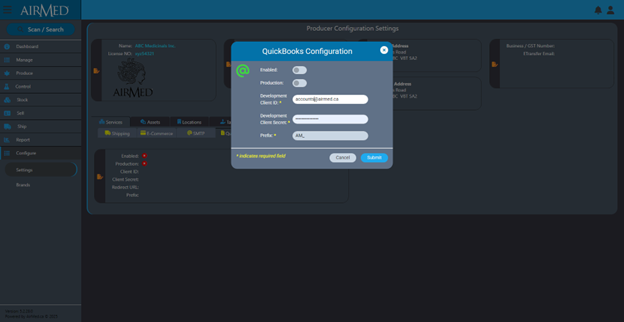
QuickBooks is a cloud-based accounting software suite designed for small to medium-sized businesses, offering tools for managing finances, tracking income and expenses, creating invoices, and handling payroll. QuickBooks from Intuit streamlines accounting tasks, automates workflows, and provides insights into business performance.
AirMed has added comprehensive integration with QuickBooks Online including full support for synchronizing AirMed Orders with QuickBooks Invoicing. This integration includes automatically creating item variants, customer organizations, as well as tax and term synchronization.
When you build an order in AirMed and release it to Production, you can automatically create an invoice in QuickBooks Online with all the same details. Modifications to orders in AirMed can automatically update QuickBooks with the corresponding changes.
The benefits of this kind of integration are numerous, especially for cannabis businesses navigating complex regulations and needing precise financial tracking.
Seed-to-Sale Tracking: AirMed excels at tracking products from cultivation to sale. Integrating this data with QuickBooks ensures that your financial records align perfectly with your inventory and operational data.
Eliminating Manual Data Entry: Our integration with QuickBooks not only saves significant time but also reduces the potential for human error that can occur with manual data entry.
Reporting & Audits: With both systems contributing to data management and audit trails, financial reporting is faster, and month-end closes are a breeze.
Real-time Financial Insights: AirMed already offered real-time data access and reporting, but with data flowing seamlessly to QuickBooks, you gain more visibility into your financial health.
If you are already familiar with QuickBooks, AirMed’s integration lets you leverage that familiarity, making it even easier to see your sales performance and profitability for faster, more informed decision-making.
For more information about AirMed features and functionality visit our Software page.

Profile: Canadian Cannabis Tourism Alliance
The Canadian Cannabis Tourism Alliance (CCTA) is at the forefront of establishing Canada as the world’s premier cannabis tourism destination. This dynamic organization comprises business owners, advocates, and cannabis professionals united by a common goal: to build a vibrant and sustainable cannabis tourism industry nationwide.
The CCTA is actively engaged in advocating for crucial policy changes, pushing for regulations that would enable everything from cannabis sales at public events to the establishment of consumption lounges. Their forward-thinking approach, evident in their 2024 plan to position Canada as the global cannabis tourism hub, highlights their commitment to shaping a responsible and thriving sector.
Beyond advocacy, the CCTA fosters industry growth through education, partnership development, and facilitating new business opportunities. They’ve already showcased their dedication with events like the “420 Cannabis Tourism ExtravaGanja” in Niagara Falls in April 2025, demonstrating their practical efforts to bring cannabis tourism experiences to life for consumers and professionals alike.
For more information including how to join, visit:
https://www.canadiancannabistourism.com/

Stratcann’s Growing Relationships Event Series
Growing Relationships is StratCann’s signature event series that brings together producers, retailers, and service providers in the cannabis industry for conversation, innovation, and collaboration. This B2B event is a full day experience, with a focus on the region’s independent cannabis brands and businesses.
Upcoming events in 2025 include:
- July 28: Mission BC
- August 15: Moncton NB
- August 19: Ottawa ON
- September 19: Nanaimo BC
- October 6: Kelowna BC
For more information visit: https://stratcann.com/growing-relationships/

AirMed: Scalable Software for Your Cannabis Business
Last week we discussed building a scalable and sustainable business. Read the post here: Sustainably Scaling Your Cannabis Business.
Creating a cannabis business that is both scalable and sustainable is the best way to deal with an uncertain economy. One of the keys to scalability lies in having tools that can handle a varying volume of transactions, inventory, and data.
Our cannabis management software is designed with scalability in mind. Whether you’re a startup or a large enterprise, our platform grows with you.
Scaling up operations can mean more complex processes, such as adding new product lines, expanding to new locations, or hiring additional staff. AirMed lets you handle these complexities with ease. Features such as multi-location support, role-based access, and centralized reporting help you streamline processes and avoid bottlenecks.
AirMed manages every aspect of cultivation, processing, packaging, and distribution. We also offer quality management, workforce management, CRM and ERP-level functionality.
You can automate a series of tasks and assign them to different departments or users with activities cascading across the entire production cycle. Plan templates let you create formulas after completing the cultivation, drying and packaging of a successful batch. Our software automates inventory management and monitors stock levels in real-time to let you adjust to fluctuating demand.
With integrated tools for sales reporting, AirMed can provide data-driven insights to help you make smarter decisions. Whether it’s forecasting sales trends, identifying popular products, or tracking seasonal demand, data becomes even more valuable as the economy fluctuates.
Our system is module to let you add functionality if and when needed. We also offer flexible billing options, and we’re currently developing a lower-cost ‘lite’ version of AirMed to help micros. A limited feature set and simplified workflows will get your smaller operation up and running while ensuring that you meet compliance and stay within budget.
Investing in scalable software ensures that your business can handle changing demand, variable inventories, and flexible operations to set the stage for long-term success. With the right system in place, you can focus on your business, while knowing that your operations are efficient, compliant, and sustainable.
For more information visit our Software page or our Compliance page.

Sustainably Scaling Your Cannabis Business
As the cannabis industry fluctuates, businesses must be prepared to scale operations depending on demand. Building a scalable, but also sustainable, cannabis operation is about more than just sales or product. It’s about creating a foundation that allows your business to deal with varying volumes of transactions, inventory, and data without introducing inefficiencies or compliance risks. Your operations should be flexible enough to accommodate your current demands while being adaptable to whatever the future has in store.
Scaling Up
During upturns, your sales volume and inventory size will inevitably increase, so your operations must be able to handle that. Your production may become more complex as a result, and you may want to expand. Whether you’re adding new product lines, opening new facilities, or hiring additional staff, be conscious of overbuilding infrastructure in case of a downturn. If you do decide to invest, look for systems that will support long-term efficiency. And ensure that whatever you scale up can be scaled back if needed.
1. Increase operations incrementally or modularly. Add capacity in blocks based on actual demand, or partner with those who can provide what you lack to reduce up-front costs.
2. Maintain your cash flow and build reserves during growth phases to cushion slumps. Avoid overleveraging and watch your ‘burn rate.’ Scale in ways that don’t push your operating expenses to unsustainable levels.
3. Grow where you’re strongest. Deepen presence in high-margin, high-loyalty markets before chasing expansion. Defend your base by building brand equity and customer loyalty with retention strategies before aggressively acquiring new customers or markets.
4. Diversify selectively. If you want to diversify, offer a mix of premium and budget-friendly options to serve customers in both boom and bust conditions. If feasible, expand into sectors or geographies less exposed to fluctuations.
5. Invest in people, culture, and leadership. For long-term sustainability, hire selectively and cross-train to build a team that can wear multiple hats if needed. Encourage adaptability, learning, and resourcefulness. Create strong leaders, a key to weathering uncertainty.
Scaling Down
During a slow economy, the best way to deal with a situation that seems beyond your control is to ensure that you have control over everything you can.
1. Streamline operations and optimize cultivation to reduce waste and increase profits. For example, using data analysis on lighting, nutrients, and water usage can increase yield without compromising quality.
2. Prioritize high-margin products and markets. Evaluate strains, product formats (e.g., pre-rolls, vapes), and brands to determine which sell reliably and offer the healthiest margins. Increase or reduce efforts in specific markets depending on performance metrics.
3. Incentivize loyalty. Offer discounts, product education, or other incentives to existing clients and partners. Encourage pre-paid orders or early payment discounts to improve cash flow.
4. Communicate transparently. Be upfront with all stakeholders about the current conditions. Encourage ideas from frontline workers on efficiency and even company direction, and show investors you’re taking disciplined, strategic action.
5. Utilize scalable systems and tools. Your equipment, software and services should scale with your business needs. Discuss temporary options with your vendors such as reduction of services to control short-term costs while maintaining long-term relationships.
Conclusion
By staying agile and innovative, you can pivot quickly when needed. And by utilizing all available data, you can improve decision making throughout your operations. This will help you invest selectively in growth-enablers to give you the best return on investment (ROI) whatever the economy throws at you.
For more information visit our Software page or our Compliance page.

Profile: ABLE BC, the voice of BC’s cannabis stores
The Alliance of Beverage Licensees (ABLE BC) is the voice of British Columbia’s bars, pubs, and private liquor and cannabis stores.
A non-profit organization funded by membership dues, ABLE’s mission is to help British Columbia’s liquor and cannabis businesses succeed.
On behalf of the organization’s 1,000 members, ABLE BC works with all levels of government to create business-friendly policies and enhance private sector opportunities.
Headquartered in Vancouver, the association offers advocacy work, member benefits and discounts, and direct access to the latest industry information and policy expertise for cannabis retail members.
According to the organization’s website, ABLE BC “works hard every single day to advocate for your interests, protect your businesses, and help ensure the survival of the cannabis retail and private liquor industries.”
For more information and to sign up for ABLE BC’s free newsletter, visit:
https://ablebc.ca/

Cannabis Europa 2025: June 24-25 in London, England

Join 1,500+ influential leaders from thriving cannabis companies, investors actively deploying capital into the market, plus key politicians — the crucial combination needed to drive the European cannabis industry and your business forward.
Cannabis Europa will once again be holding a boutique industry expo, showcasing more than 40 leading businesses as the cream of the European cannabis crop, acting as a jumping off point for growing your business in Europe and beyond.
Cannabis Europa is where the visionaries, policymakers, and business leaders shaping Europe’s cannabis landscape will converge. 2025’s conference will explore Europe’s distinct path forward, emphasising clinical excellence, regulatory integrity, and a focus on sustainability that sets the region apart as a global benchmark for cannabis standards.
For more information visit: https://www.cannabis-europa.com/