
Hemp Regulations: Government of Canada Consultation until June 30
The Government of Canada is inviting comment on potential amendments to the Industrial Hemp Regulations. The amendments aim to reduce regulatory requirements and administrative burden, while continuing to meet our public health and public safety objectives.
“These changes would support our commitment to reducing regulatory red tape, while maintaining key control measures for industrial hemp.”
The focus of this consultation includes the following stakeholders.
- current and potential industrial hemp licence holders
- industrial hemp industry associations
- cannabis licence holders
- cannabis industry associations
- Indigenous groups
- professional associations
- federal partners (departments and agencies)
- provinces and territories
The Notice of Intent was published in the Canada Gazette, Part I on May 16, 2026 and the deadline to submit comments is June 30, 2026.
To participate, send your comments in an email to cannabis.consultation@hc-sc.gc.ca. Use the subject line: “Consultation on potential amendments to the Industrial Hemp Regulations”.
For more information visit: Government of Canada
To read the official announcement visit: Government of Canada Gazette

Profile: Retail Cannabis Council of Manitoba
The Retail Cannabis Council of Manitoba (RCCMB) is the unified, non-partisan advocate for independent cannabis retailers across the province, dedicated to fostering a safe, equitable, and sustainable industry. We serve as a respected voice at the local, provincial, and national government levels, actively representing retailers in discussions regarding legal and regulatory frameworks.
The mission of the RCCMB is to empower independent business owners by ensuring their interests are prioritized before regulatory changes are enacted. By advocating for fair regulations, the elimination of red tape, and the eradication of the illicit market, we work to cultivate a legal cannabis sector that benefits communities, businesses, and consumers alike.
The Council is committed to advancing the interests of its members by providing essential representation, shaping policies that encourage sector growth, and promoting high-quality, safe industry standards.
Through collaboration with government bodies, industry stakeholders, and the public, the RCCMB fosters an environment where independent cannabis retailers can thrive while contributing to a responsible and robust provincial market.
For more information please visit: https://rccmb.ca/

Tax Reform Advocacy in Canada’s Cannabis Industry
On April 23, 2026, the Cannabis Council of Canada (C3)—the national voice for Canada’s licensed producers and processors—submitted a significant update to the Office of the Commissioner of Lobbying. This isn’t just another routine filing; it is a formal, data-backed demand for the federal government to address the “punitive” tax regime that is currently stifling the legal market.
C3 is actively engaging with departments like Finance Canada and Innovation, Science and Economic Development (ISED) to deliver a clear message: The tax framework built in 2018 is broken, and 2026 must be the year it is fixed.
The core of C3’s argument centres on a massive disconnect between policy intent and practical reality. When legalization was first proposed, the excise tax was intended to be $1 per gram or 10% of a producer’s sale price—whichever was higher. The assumption was that wholesale prices would remain high enough that 10% would be the standard.
However, as wholesale prices have dropped to accommodate a competitive legal market, that “fixed” $1 per gram has become a heavy weight. C3’s latest filing highlights that for many high-volume, value-tier products, the excise tax now effectively hits nearly 30% of gross revenue. This “Excise Gap” is the primary reason many LPs are struggling with financial sustainability while the illicit market continues to operate tax-free.
As we move through 2026, C3’s work in Ottawa will be the most important story for every producer in the country. It’s time for a tax framework that reflects the reality of the market today, not the guesses made eight years ago.
You can support the Cannabis Council of Canada by visiting their Advocacy Hub where you can find resources to help educate your local MP and community about the need for a sustainable excise cap. https://www.cannabis-council.ca/advocacy
Profile: Cannabis Council of Canada
The Cannabis Council of Canada (C3) is the national and international voice for Canada’s licensed cannabis producers and processors, advocating for a safe, competitive, and responsible industry. We promote high standards, foster economic growth, and work to ensure integrity within the regulated market. By advocating for fair regulations, high-quality standards, and economic opportunities, we work to ensure public safety, and foster a legal market that benefits communities, businesses, and consumers alike. Committed to eliminating the illicit market, we strive to strengthen Canada’s legal cannabis sector while driving innovation and economic opportunities. As the trusted national resource on the Canadian Cannabis industry, we engage with stakeholders to support the industry’s continued development and responsible use for both medical and recreational purposes.
The mission of the Cannabis Council of Canada is to advocate for and promote a healthy, trusted, and competitive cannabis market that empowers Canada’s Licensed Producers to deliver high-quality, rigorously tested products to consumers while ensuring long-term financial sustainability.
The C3 Advocacy Roadmap
C3’s mission in 2026 is built on three specific pillars of reform aimed at stabilizing the sector:
The 10% Ad Valorem Cap: C3 is lobbying to replace the $1-per-gram minimum with a hard cap at 10% of the producer’s selling price. This would immediately restore margins and allow legal producers to compete fairly on price.
National Stamp Harmonization: Currently, producers must navigate a logistical nightmare of province-specific excise stamps. C3 is pushing for a single national stamp to streamline supply chains and reduce operational costs.
The Medical Exemption: A renewed effort to eliminate excise tax on medical cannabis, ensuring that patients aren’t taxed for accessing their medication.
The Cannabis Council is committed to advancing the interests of its members by providing essential industry resources, engaging with policymakers to shape fair and progressive regulations, and championing policies that encourage sector growth while reducing unnecessary operational and financial burdens.
Through collaboration with industry stakeholders, government bodies, and the public, the Council fosters an environment where innovation, consumer safety, and responsible business practices drive the future of Canada’s legal cannabis industry.
For more information please visit: https://www.cannabis-council.ca/
Profile: C-45 Quality Association
The C-45 Quality Association is committed to advancing excellence in Canada’s cannabis industry by promoting quality production practices, fostering sustainable and inclusive growth, and driving innovation. Through education, industry events, and strategic partnerships, we provide platforms for knowledge-sharing, professional development, and networking. We educate and inform consumers, producers, and regulators about the benefits of high standards, host events that bring together industry leaders and emerging voices, and offer resources that empower professionals at all levels to thrive. Our mission is to build a collaborative and resilient industry that reflects the highest quality, integrity, and continuous learning.
The Association strives to protect the public interest by engaging its members in the cannabis industry to arrive at sound practices that strengthen the industry and ensure safe and effective cannabis management throughout all of Canada, and globally, as the industry matures. The Association also endeavours to provide members with access to valuable knowledge, networks and resources that will assist members in improving and advancing their careers.
For more information please visit: https://www.cannabis-council.ca/
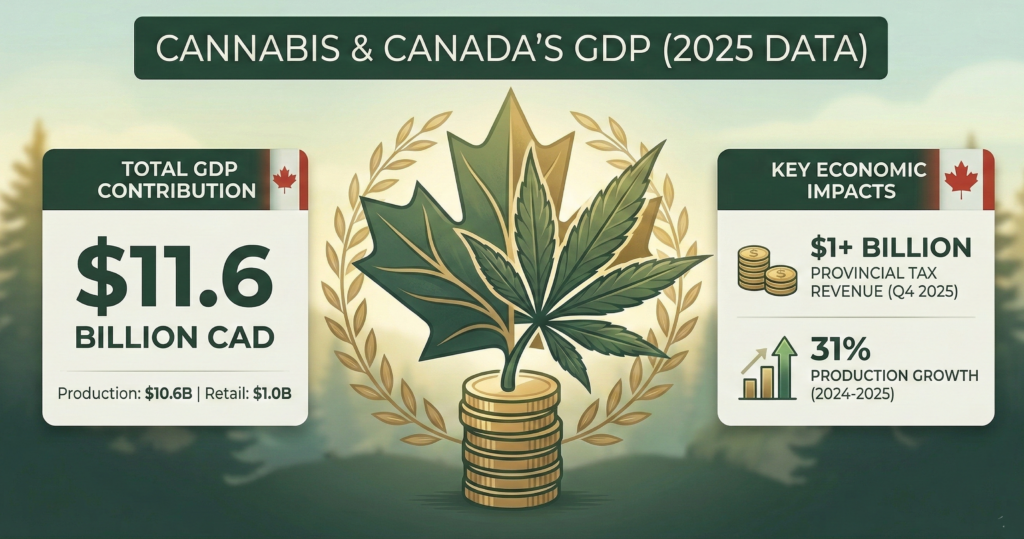
Canada’s Cannabis Sector Contributes $11.6 Billion to National GDP
Recent economic data from Stratcann and other sources indicates that the cannabis industry continues to be a significant driver of the Canadian economy.
In 2025, the sector’s total contribution to the national GDP reached approximately $11.6 billion. Notably, the licensed production and processing segment accounted for the vast majority of this impact, contributing $10.6 billion. This represents a steady increase over previous years, highlighting the industry’s maturation and its role as a more substantial economic contributor than several other traditional agricultural and beverage sectors.
The data underscores the long-term viability of the sector and provides a factual basis for ongoing discussions regarding industry regulation and economic policy. Licensed production now contributes more to the national GDP than industries such as air transportation and meat product manufacturing.
The data is primarily derived from Statistics Canada. The 11.6 billion dollar figure for 2025 is based on real-time and monthly gross domestic product data tracked by industry. These figures are calculated using chained 2017 dollars to provide a consistent comparison over time across various economic sectors. Another major source for these figures is a comprehensive economic study released in September 2025 titled High Impact, Green Growth: The Economic Footprint of Canada’s Cannabis Industry. This report was a collaborative effort between the Business Data Lab at the Canadian Chamber of Commerce and Organigram Global. While the study found an even higher total economic impact of 16 billion dollars when including indirect and induced effects, it used the raw underlying data provided by Statistics Canada to perform its modeling.

Profile: AQIC (Association québécoise de l'industrie du cannabis)
With over 120 members, the Quebec Hemp and Cannabis Industry Association (AQIC) is committed to working with government and stakeholders to advance the Quebec hemp and cannabis industry to its full potential and encourage innovation through science and technology.
The AQIC provides a space to share information and reflect upon common challenges and opportunities. The Association was founded in 2019, on the principle that we can accomplish more together. And by working together as one voice, we can advance our common goals of raising the bar on a safe and sustainable industry in Quebec.
The association’s mission is to represent the Quebec hemp and cannabis industry and contribute in a constructive and responsible manner to its development.
The AQIC also plays an educational role by educating the general public about hemp and cannabis consumption. We also monitor and analyze current policies, advocate for changes in the cannabis and hemp legislation and provide recommendations to provincial and federal government officials.
For more information please visit: https://aqic.ca/

Profile: Ontario Cannabis Association
The Ontario Cannabis Association (OCA) is a non-profit organization that represents licensed producers and processors in the province. The association’s mission is to be a collective voice for its members, working to strengthen the cannabis industry in Ontario using the guiding principles: Unite, Advocate, and Elevate.
The OCA’s work is based on several key pillars:
Advocacy: It actively champions the interests of its members by engaging with government officials and the Ontario Cannabis Store (OCS) to influence policy and regulation.
Collaboration: The association fosters partnerships with other organizations, including the Ontario Farmers Association and legacy market participants, to help them transition into the legal market.
Business Support: The OCA facilitates networking and knowledge-sharing among its members and leverages its relationships with suppliers to secure exclusive benefits and discounts.
Quality Assurance: The organization is developing a quality assurance labeling system to distinguish its members’ products and promote high standards of business practices and product quality.
The association is working to build a more inclusive, diverse, and economical cannabis industry in Ontario while ensuring the long-term success of its members and establishing a trusted and reputable legal market.
For more information please visit:
https://www.ontariocannabisassociation.ca/

Profile: Alberta Cannabis Micro Licence Association
The Alberta Cannabis Micro Licence Association (ACMLA) is a non-profit organization that provides a unified voice for small-scale cannabis producers in Alberta. The association’s membership is comprised of micro-license holders, applicants, and other industry supporters.
The ACMLA’s mission is centered on advocacy, education, and collaboration. The group works directly with all levels of government to support the growth of the province’s craft cannabis sector. Key goals include shaping the industry’s future through policy reform, promoting low-cost sales channels like farm-gate operations, and reducing barriers for new entrants. The association also focuses on improving business practices and quality control for its members by sharing resources and best practices.
Beyond industry support, the ACMLA aims to foster broader economic opportunities, such as promoting cannabis tourism within Alberta. The association is also dedicated to combating the stigma surrounding cannabis through evidence-based education. By uniting its members, the ACMLA strives to create a more competitive and vibrant cannabis landscape that benefits small producers and the broader community.
For more information please visit:
https://acmla.ca/

Deloitte Report: Six Years of Legalization
The industry analysts at Deloitte have released a new report titled Six Years of Legalization: The Economic and Social Impact of Canada’s Cannabis Sector. This report examines the industry’s economic contribution from legalization through 2024, with a focus on both Ontario and the broader Canadian economy. The report finds that over the six-year period, the industry invested $42.0 billion in capital expenditures, and generated $28.7 billion in sales nationwide, primarily driven by the sales of recreational cannabis products.
Read more about the report here: https://www.deloitte.com/ca/en/Industries/consumer-products/research/an-industry-makes-its-mark.html

Profile: BC Cannabis Alliance
The BC Cannabis Alliance (BCCA) is a non-profit organization that serves as a collective voice for British Columbia’s licensed craft cannabis producers. Rooted in the province’s tradition of high-quality, small-batch cannabis, the BCCA advocates for a sustainable and thriving industry that supports rural economies and creates skilled jobs.
The alliance operates on a cooperative model, with a mission to help maintain BC’s status as a global leader in cannabis innovation. It works to provide small and medium-sized producers with a safe, legal, and sustainable alternative to the illicit market. Key goals include accelerating market access, establishing a retail network for its members, and achieving economies of scale to ensure these producers can compete with larger corporations.
A core function of the BCCA is government advocacy. The organization works to reform provincial and federal policies by addressing issues like excessive taxation, regulatory burdens, and competition from the unregulated market. It actively pushes for changes such as a more equitable excise tax structure, direct delivery reporting reforms, and grants for cannabis manufacturing. By championing causes like fair farm status exemptions and aligning licensing fees with other agricultural sectors, the BCCA aims to create a more supportive environment for BC’s craft cannabis industry.
For more information including how you can help, visit:
https://www.bccannabisalliance.com/
Profile: Canadian Cannabis Tourism Alliance
The Canadian Cannabis Tourism Alliance (CCTA) is at the forefront of establishing Canada as the world’s premier cannabis tourism destination. This dynamic organization comprises business owners, advocates, and cannabis professionals united by a common goal: to build a vibrant and sustainable cannabis tourism industry nationwide.
The CCTA is actively engaged in advocating for crucial policy changes, pushing for regulations that would enable everything from cannabis sales at public events to the establishment of consumption lounges. Their forward-thinking approach, evident in their 2024 plan to position Canada as the global cannabis tourism hub, highlights their commitment to shaping a responsible and thriving sector.
Beyond advocacy, the CCTA fosters industry growth through education, partnership development, and facilitating new business opportunities. They’ve already showcased their dedication with events like the “420 Cannabis Tourism ExtravaGanja” in Niagara Falls in April 2025, demonstrating their practical efforts to bring cannabis tourism experiences to life for consumers and professionals alike.
For more information including how to join, visit:
https://www.canadiancannabistourism.com/

Health Canada Revises Certain Cannabis Regulations
For the purposes of streamlining requirements, Health Canada has amended certain regulations concerning cannabis.
Canadian cannabis news site Stratcann published an article on March 12 discussing the revisions.
“The regulation changes focus on five key areas: licensing, production, packaging and labelling, security, and record keeping. The government’s goal with these changes is to address some of the challenges expressed by the industry while maintaining the key public health and safety concerns within the federal Cannabis Act.”
In the new regulations, which were made official in February and took affect last week, production limits for micros increased, and requirements for non-human and non-animal research testing decreased.
Another revision omitted the printed “Consumer Information Document” requirement that in the past had to accompany every shipment of cannabis in Canada.
There were also revisions for hemp producers.
Read a summary revised regulations here: https://www.canada.ca/en/health-canada/services/publications/drugs-health-products/summary-changes-following-streamlining-regulations.html
Read the Stratcann article on the changes here: https://stratcann.com/other/updates-cannabis-rules-regulations-now-public/

Still Proudly Canadian-Owned and Operated
After more than 10 years in business, we are incredibly proud to remain 100 percent Canadian-owned and operated. From day one, our mission has been clear: to provide world-class products and services while staying true to our Canadian roots.
Every decision we make is guided by our commitment to support the Canadian cannabis industry — from Cape Scott to Cape Spear and every point in between.
With hard work, innovation, and the continued loyalty of our customers, we’ve built something truly special and truly Canadian.
Through our second decade in business, we hope to continue serving you with the same passion, dedication, and Canadian pride that has defined us since 2014.
Take a tour of AirMed to see what homegrown can do for you. Call us today at (877) 313-2442 or use the Request Demo button at the top of the page.
In the meantime, visit our Software page.