
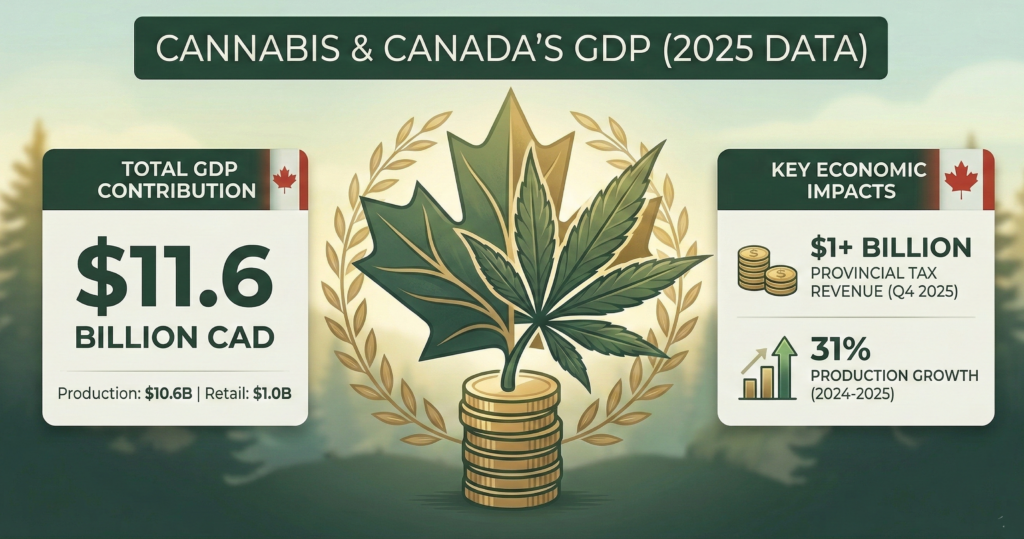
Recent economic data from Stratcann and other sources indicates that the cannabis industry continues to be a significant driver of the Canadian economy.
In 2025, the sector’s total contribution to the national GDP reached approximately $11.6 billion. Notably, the licensed production and processing segment accounted for the vast majority of this impact, contributing $10.6 billion. This represents a steady increase over previous years, highlighting the industry’s maturation and its role as a more substantial economic contributor than several other traditional agricultural and beverage sectors.
The data underscores the long-term viability of the sector and provides a factual basis for ongoing discussions regarding industry regulation and economic policy. Licensed production now contributes more to the national GDP than industries such as air transportation and meat product manufacturing.
The data is primarily derived from Statistics Canada. The 11.6 billion dollar figure for 2025 is based on real-time and monthly gross domestic product data tracked by industry. These figures are calculated using chained 2017 dollars to provide a consistent comparison over time across various economic sectors. Another major source for these figures is a comprehensive economic study released in September 2025 titled High Impact, Green Growth: The Economic Footprint of Canada’s Cannabis Industry. This report was a collaborative effort between the Business Data Lab at the Canadian Chamber of Commerce and Organigram Global. While the study found an even higher total economic impact of 16 billion dollars when including indirect and induced effects, it used the raw underlying data provided by Statistics Canada to perform its modeling.