

Stratcann’s Growing Relationships Burlington Oct 21, 2026
Stratcann announced that it is excited to return to southern Ontario, bringing Growing Relationships back to Burlington
Growing Relationships is a one-day B2B event designed to support real business outcomes in the Canadian cannabis industry. By bringing together retailers, producers, and industry service providers in a focused, regional setting, the event creates space for meaningful conversations, stronger relationships, and insights that translate into action after the event.
Growing Relationships offers an efficient way to connect with multiple industry stakeholders in one day — reducing noise while increasing the quality of engagement. Attendees consistently value the opportunity to step out of transactional conversations and into discussions that lead to follow-ups, collaboration, and long-term partnerships.
Our events are intentionally delivered in underserved communities across Canada to increase access to industry gatherings, strengthen regional ecosystems, and ensure that voices from across the country are part of the broader industry conversation.
The Burlington event will feature curated networking activities and industry roundtable discussions, with a strong focus on shared solutions and peer-to-peer learning. An essential component of Growing Relationships is active community participation—creating space for diverse perspectives on current industry challenges and for candid discussion of how the industry can operate more effectively.
For more information visit: https://stratcann.com/growing-relationships/

Stratcann’s Growing Relationships Kamloops Sep 21, 2026
Hosted by Stratcann, Growing Relationships is a one-day B2B event that brings together retailers, producers, and industry services for networking, brainstorming, discussion, and learning. It’s designed to support business growth by providing opportunities and space to build connections, share insights, and participate in community conversations.
The Kamloops event will feature curated networking activities and industry roundtable discussions, with a strong focus on shared solutions and peer-to-peer learning. An essential component of Growing Relationships is active community participation—creating space for diverse perspectives on current industry challenges and for candid discussion of how the industry can operate more effectively.
For more information visit: https://stratcann.com/growing-relationships/

Canada Day 2026: The Road We’ve Travelled
On this Canada Day we’d like to reflect on the road legalized cannabis has travelled in Canada so far.
2001: Medical Cannabis Framework Evolution
The Marihuana Medical Access Regulations (MMAR) came into force on July 30, 2001. This was Canada’s original medical cannabis framework, establishing the first legal pathways for patient possession and personal production licenses. MMAR was created to give patients a secure, legal supply of cannabis if they suffered from terminal illnesses or severe chronic conditions (like multiple sclerosis, spinal cord injuries, or severe arthritis). Before the MMAR, possessing or producing cannabis for any reason was strictly a criminal offense. The MMAR changed the legal landscape by establishing that Canadians had a constitutional right to access cannabis if a physician deemed it medically necessary.
2013: Marihuana for Medical Purposes Regulations (MMPR)
While groundbreaking, the MMAR model faced several practical challenges, so Health Canada decided to phase out the MMAR and transition to a commercialized, highly regulated system with strict quality control. This led to the creation of the MMPR, which removed home-grows entirely and birthed the modern “Licensed Producer” (LP) industry that exists today.
The initial implementation of MMPR occurred on June 19, 2013. This regulation created the commercial framework, shifting production away from home-grows toward a regulated network of licensed commercial producers (LPs). MMPR fully replaced MMAR April 1, 2014.
2016: Access to Cannabis for Medical Purposes Regulations (ACMPR)
ACMPR was announced August 11, 2016 and came into Force: August 24, 2016 and was enacted following the Allard v. Canada court ruling. This framework combined the commercial LP structure of the MMPR while restoring the legal right for authorized patients to grow a limited supply at home.
2017: Cannabis Act (Bill C-45)
The Cannabis Act established the framework for recreational (adult-use) cannabis in Canada. Bill C-45 was passed by the House of Commons on November 27, 2017, with the final senate vote on June 19, 2018. The act received Royal Assent and became law. on June 21, 2018, but officially came into force on October 17, 2018, known as Legalization Day in Canada.
This officially replaced the previous medical regulations (subsuming medical access under the broader Cannabis Act) and fully legalized adult-use recreational dried flower and oils nationwide.
2019: Amended Cannabis Regulations (“Cannabis 2.0”)
Exactly one year later, on October 17, 2019, amendments legally permitted the production, distribution, and sale of alternative product formats, specifically edibles, extracts, and topicals.
2022: The Beverage Equivalency “Math Fix”
Early regulations suffered from a flawed math formula regarding public possession limits for liquid cannabis beverages. In December 2022 Health Canada corrected the formula, unlocking the commercial potential of the cannabis beverage category.
2025: “Omnibus” Regulatory Streamlining
Following the independent Expert Panel’s legislative review, Health Canada introduced a massive regulatory relief package to alleviate administrative burdens on Licensed Producers (LPs).
2026: Packaging and Labelling Modernization
In March 2026, a major shift in packaging rules hit full enforcement. The initial, heavily restrictive “plain packaging” mandates were updated to support eco-friendly initiatives and better consumer education.
2026: Mature Market
Today, the cannabis market in Canada is a highly mature, disciplined industry focused on margin protection and hyper-localized supply chains. Statistics Canada figures show that small independent operators form the true backbone of the market—over 51% of legal retail stores employ fewer than four people, and micro-cultivation licenses remain the most popular category. General volume-driven cannabis has faced heavy price compression. To survive, smaller cultivators are relying on hands-on methods (hand-trimming, hang-drying, rare genetics) to earn formal “Craft” designations. Where provincial frameworks allow, micro-producers and boutique processors are shifting away from massive central distribution hubs to utilize direct-delivery capabilities, connecting directly with independent retail networks to protect product freshness and margins.
To read Health Canada’s deep dive into the legislative background, policy goals, and public health data compiled since 2018, review the Government of Canada Cannabis Act Progress Report. https://www.canada.ca/en/health-canada/programs/engaging-cannabis-legalization-regulation-canada-taking-stock-progress/document.html
For a highly detailed chronological deep dive into the country’s drug legislative changes stretching back to 1908, read the Wikipedia Legal History of Cannabis in Canada Page. https://en.wikipedia.org/wiki/Legal_history_of_cannabis_in_Canada
To explore how public opinion shifted and understand the social factors that ultimately influenced the federal government to draft Bill C-45, see The Canadian Encyclopedia Legalization Summary. https://thecanadianencyclopedia.ca/en/article/marijuana-legalization-in-canada
To listen to or read an exploration of how a virtually unknown plant became a multibillion-dollar legal market after nearly a century of bans, check out the CBC Radio: The Long, Strange Story of Pot Prohibition in Canada feature. https://www.cbc.ca/radio/ondrugs/the-long-strange-story-of-pot-prohibition-in-canada-1.4541890
Stratcann’s Growing Relationships Victoria July 16, 2026
Hosted by Stratcann, Growing Relationships is a one-day B2B event that brings together retailers, producers, and industry services for networking, brainstorming, discussion, and learning. It’s designed to support business growth by providing opportunities and space to build connections, share insights, and participate in community conversations.
The Victoria 2026 event includes networking activities and roundtable industry discussions. An essential component of Growing Relationships is engaging the community in discussions and brainstorming on current industry issues from diverse perspectives. Attendees will enjoy several networking opportunities, engaging discussions and activities, presentations, and a catered lunch.
For more information visit: https://stratcann.com/growing-relationships/
Profile: Retail Cannabis Council of Manitoba
The Retail Cannabis Council of Manitoba (RCCMB) is the unified, non-partisan advocate for independent cannabis retailers across the province, dedicated to fostering a safe, equitable, and sustainable industry. We serve as a respected voice at the local, provincial, and national government levels, actively representing retailers in discussions regarding legal and regulatory frameworks.
The mission of the RCCMB is to empower independent business owners by ensuring their interests are prioritized before regulatory changes are enacted. By advocating for fair regulations, the elimination of red tape, and the eradication of the illicit market, we work to cultivate a legal cannabis sector that benefits communities, businesses, and consumers alike.
The Council is committed to advancing the interests of its members by providing essential representation, shaping policies that encourage sector growth, and promoting high-quality, safe industry standards.
Through collaboration with government bodies, industry stakeholders, and the public, the RCCMB fosters an environment where independent cannabis retailers can thrive while contributing to a responsible and robust provincial market.
For more information please visit: https://rccmb.ca/

Tax Reform Advocacy in Canada’s Cannabis Industry
On April 23, 2026, the Cannabis Council of Canada (C3)—the national voice for Canada’s licensed producers and processors—submitted a significant update to the Office of the Commissioner of Lobbying. This isn’t just another routine filing; it is a formal, data-backed demand for the federal government to address the “punitive” tax regime that is currently stifling the legal market.
C3 is actively engaging with departments like Finance Canada and Innovation, Science and Economic Development (ISED) to deliver a clear message: The tax framework built in 2018 is broken, and 2026 must be the year it is fixed.
The core of C3’s argument centres on a massive disconnect between policy intent and practical reality. When legalization was first proposed, the excise tax was intended to be $1 per gram or 10% of a producer’s sale price—whichever was higher. The assumption was that wholesale prices would remain high enough that 10% would be the standard.
However, as wholesale prices have dropped to accommodate a competitive legal market, that “fixed” $1 per gram has become a heavy weight. C3’s latest filing highlights that for many high-volume, value-tier products, the excise tax now effectively hits nearly 30% of gross revenue. This “Excise Gap” is the primary reason many LPs are struggling with financial sustainability while the illicit market continues to operate tax-free.
As we move through 2026, C3’s work in Ottawa will be the most important story for every producer in the country. It’s time for a tax framework that reflects the reality of the market today, not the guesses made eight years ago.
You can support the Cannabis Council of Canada by visiting their Advocacy Hub where you can find resources to help educate your local MP and community about the need for a sustainable excise cap. https://www.cannabis-council.ca/advocacy
Profile: Cannabis Council of Canada
The Cannabis Council of Canada (C3) is the national and international voice for Canada’s licensed cannabis producers and processors, advocating for a safe, competitive, and responsible industry. We promote high standards, foster economic growth, and work to ensure integrity within the regulated market. By advocating for fair regulations, high-quality standards, and economic opportunities, we work to ensure public safety, and foster a legal market that benefits communities, businesses, and consumers alike. Committed to eliminating the illicit market, we strive to strengthen Canada’s legal cannabis sector while driving innovation and economic opportunities. As the trusted national resource on the Canadian Cannabis industry, we engage with stakeholders to support the industry’s continued development and responsible use for both medical and recreational purposes.
The mission of the Cannabis Council of Canada is to advocate for and promote a healthy, trusted, and competitive cannabis market that empowers Canada’s Licensed Producers to deliver high-quality, rigorously tested products to consumers while ensuring long-term financial sustainability.
The C3 Advocacy Roadmap
C3’s mission in 2026 is built on three specific pillars of reform aimed at stabilizing the sector:
The 10% Ad Valorem Cap: C3 is lobbying to replace the $1-per-gram minimum with a hard cap at 10% of the producer’s selling price. This would immediately restore margins and allow legal producers to compete fairly on price.
National Stamp Harmonization: Currently, producers must navigate a logistical nightmare of province-specific excise stamps. C3 is pushing for a single national stamp to streamline supply chains and reduce operational costs.
The Medical Exemption: A renewed effort to eliminate excise tax on medical cannabis, ensuring that patients aren’t taxed for accessing their medication.
The Cannabis Council is committed to advancing the interests of its members by providing essential industry resources, engaging with policymakers to shape fair and progressive regulations, and championing policies that encourage sector growth while reducing unnecessary operational and financial burdens.
Through collaboration with industry stakeholders, government bodies, and the public, the Council fosters an environment where innovation, consumer safety, and responsible business practices drive the future of Canada’s legal cannabis industry.
For more information please visit: https://www.cannabis-council.ca/
Stratcann’s Growing Relationships B2B Series: Calgary and Winnipeg
Hosted by StratCann, an organization dedicated to providing news and resources for the Canadian cannabis industry, the Growing Relationships event series returns this spring with one-day B2B gatherings in Calgary and Winnipeg.
These events are designed to foster direct connections between licensed producers, regional retailers, and industry service providers. Unlike larger trade shows, these regional sessions focus on intimate networking, brainstorming solutions for current industry challenges, and participating in community-led discussions.
The Calgary event takes place on April 29, 2026, at the Calgary Italian Cultural Centre.
The Winnipeg event follows on May 13, 2026, at the Norwood Hotel in the Promenade Ballroom.
For more information visit: https://stratcann.com/growing-relationships/

Profile: C-45 Quality Association
The C-45 Quality Association is committed to advancing excellence in Canada’s cannabis industry by promoting quality production practices, fostering sustainable and inclusive growth, and driving innovation. Through education, industry events, and strategic partnerships, we provide platforms for knowledge-sharing, professional development, and networking. We educate and inform consumers, producers, and regulators about the benefits of high standards, host events that bring together industry leaders and emerging voices, and offer resources that empower professionals at all levels to thrive. Our mission is to build a collaborative and resilient industry that reflects the highest quality, integrity, and continuous learning.
The Association strives to protect the public interest by engaging its members in the cannabis industry to arrive at sound practices that strengthen the industry and ensure safe and effective cannabis management throughout all of Canada, and globally, as the industry matures. The Association also endeavours to provide members with access to valuable knowledge, networks and resources that will assist members in improving and advancing their careers.
For more information please visit: https://www.cannabis-council.ca/
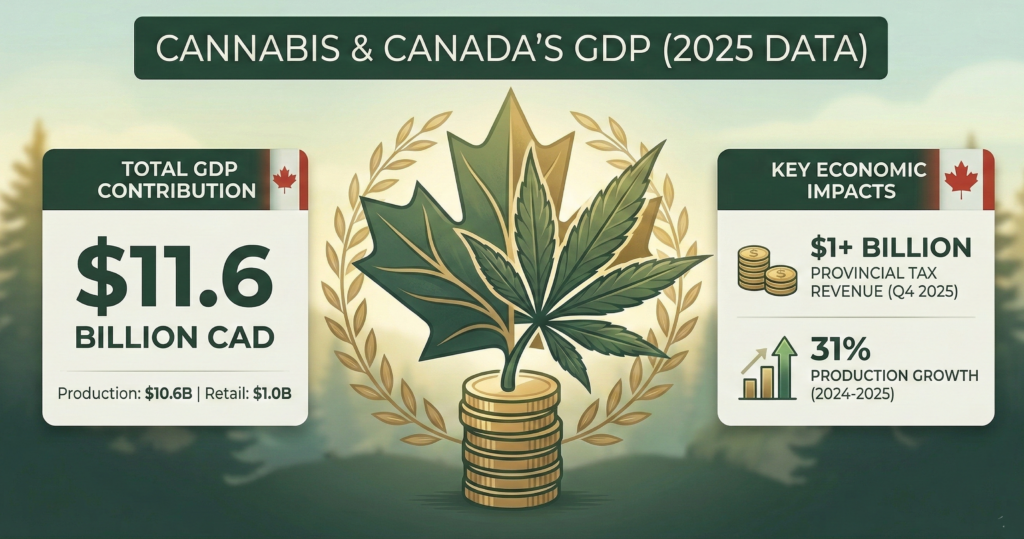
Canada’s Cannabis Sector Contributes $11.6 Billion to National GDP
Recent economic data from Stratcann and other sources indicates that the cannabis industry continues to be a significant driver of the Canadian economy.
In 2025, the sector’s total contribution to the national GDP reached approximately $11.6 billion. Notably, the licensed production and processing segment accounted for the vast majority of this impact, contributing $10.6 billion. This represents a steady increase over previous years, highlighting the industry’s maturation and its role as a more substantial economic contributor than several other traditional agricultural and beverage sectors.
The data underscores the long-term viability of the sector and provides a factual basis for ongoing discussions regarding industry regulation and economic policy. Licensed production now contributes more to the national GDP than industries such as air transportation and meat product manufacturing.
The data is primarily derived from Statistics Canada. The 11.6 billion dollar figure for 2025 is based on real-time and monthly gross domestic product data tracked by industry. These figures are calculated using chained 2017 dollars to provide a consistent comparison over time across various economic sectors. Another major source for these figures is a comprehensive economic study released in September 2025 titled High Impact, Green Growth: The Economic Footprint of Canada’s Cannabis Industry. This report was a collaborative effort between the Business Data Lab at the Canadian Chamber of Commerce and Organigram Global. While the study found an even higher total economic impact of 16 billion dollars when including indirect and induced effects, it used the raw underlying data provided by Statistics Canada to perform its modeling.

Framework for Clinical Trials: Government of Canada Consultation
Health Canada is seeking feedback on the proposed Clinical Trials Regulations for drugs (pharmaceuticals, biologics and radiopharmaceuticals) and on multiple guidance documents related to the proposal. The proposed framework would replace the clinical trial regulatory schemes for drugs in the following sections of the regulations:
Part C, Division 5 of the Food and Drug Regulations and
Part 2 of the Clinical Trials for Medical Devices and Drugs Relating to COVID-19 Regulations
This proposed framework aims to improve access to new and innovative therapies for people in Canada while maintaining strong safety protections for participants.
This initiative is part of Health Canada and the Public Health Agency of Canada’s work to streamline processes and enhance regulatory efficiency.
The consultation is open until March 20, 2026.
- For more information visit: Government of Canada
- To read a legal discussion about this visit: Pharmain Brief
- To read the official announcement visit: Government of Canada Gazette

Profile: AQIC (Association québécoise de l'industrie du cannabis)
With over 120 members, the Quebec Hemp and Cannabis Industry Association (AQIC) is committed to working with government and stakeholders to advance the Quebec hemp and cannabis industry to its full potential and encourage innovation through science and technology.
The AQIC provides a space to share information and reflect upon common challenges and opportunities. The Association was founded in 2019, on the principle that we can accomplish more together. And by working together as one voice, we can advance our common goals of raising the bar on a safe and sustainable industry in Quebec.
The association’s mission is to represent the Quebec hemp and cannabis industry and contribute in a constructive and responsible manner to its development.
The AQIC also plays an educational role by educating the general public about hemp and cannabis consumption. We also monitor and analyze current policies, advocate for changes in the cannabis and hemp legislation and provide recommendations to provincial and federal government officials.
For more information please visit: https://aqic.ca/

Pivoting After Health Canada’s CBD NHP Ruling
Why the Medical Channel is Now the Primary Path for CBD
The start of 2026 has brought a significant shift for the Canadian cannabis industry. In a move that surprised many stakeholders, Health Canada recently removed the long-awaited proposal for Natural Health Products (NHPs) containing CBD from its forward regulatory plan. For years, producers and consumers alike hoped for a “third stream” for CBD—one that would allow non-intoxicating cannabidiol to be sold on pharmacy shelves and in health food stores alongside vitamins and supplements. With that pathway now effectively stalled, the industry must pivot.
Here is what the removal of the CBD NHP proposal means for your business and how you can navigate this “Medical-First” landscape.
What Happened?
On January 8, 2026, industry news outlets reported that the regulatory framework designed to create a “pathway for health products containing cannabidiol” had been stripped from the government’s upcoming agenda. This follows years of consultations that began back in 2019.
Is the Medical Channel the Only Way Forward?
For producers focused on the wellness and therapeutic benefits of CBD, the answer is increasingly “yes.” Without an NHP pathway, CBD remains locked behind the same regulatory requirements as THC.
However, this isn’t necessarily a setback—it’s a clarification of the market. The Medical Cannabis Channel remains the only legal way for producers to provide CBD to patients with professional healthcare oversight and without the “recreational” stigma of the adult-use retail environment.
How AirMed Supports Your Pivot to Medical
If your business strategy relied on CBD NHPs, now is the time to double down on your medical sales infrastructure. AirMed was built from the ground up to support the complex requirements of medical cannabis sales in Canada.
1. The AirMed WordPress Medical Plugin
Your website needs to be more than a digital brochure; it needs to be a secure patient portal. Our WordPress Medical Plugin allows you to:
- Manage Patient Registration: Streamline the intake of medical documents and healthcare practitioner (HCP) authorizations.
- Secure Product Catalogs: Show your CBD-dominant products only to verified medical clients, ensuring you stay compliant with strict promotion and advertising regulations.
2. Encrypted Patient Messaging
Health-focused CBD consumers often have more questions than recreational users. AirMed provides secure, encrypted messaging between your staff and your clients, allowing you to provide high-touch customer service while protecting sensitive patient data.
3. Seamless Fulfillment & Shipping
Transitioning to a direct-to-patient model requires a robust logistics engine. AirMed integrates directly with carriers and fulfillment tools (like ShipStation) to ensure that your wellness-focused clients receive their CBD products discreetly and efficiently.
The Bottom Line
The removal of the CBD NHP proposal from the 2026 regulatory plan is a reminder of the volatility of the Canadian regulatory environment. However, the demand for high-quality, health-focused CBD has never been higher. By leveraging the Medical Channel, producers can bypass the uncertainty of the NHP path and start serving patients today.
Official Context: You can monitor the current Health Canada Forward Regulatory Plan for updates here: https://www.canada.ca/en/health-canada/corporate/about-health-canada/legislation-guidelines/acts-regulations/forward-regulatory-plan.html
Industry Commentary: StratCann reported that this move leaves CBD strictly under the Cannabis Act, rather than the Natural Health Products Regulations: https://stratcann.com/news/health-canada-removes-cbd-nhp-regulation-proposal-from-forward-regulatory-plan/
And for a demonstration of our medical plugin in action, please visit: https://airmeddemo.com/

Happy New Year!
As we close the book on 2025 and welcome a new year, the team at AirMed pauses to reflect on the depth and complexity of Canada’s cannabis journey.
Turning the calendar page to a new year, we take this moment to recognize the perseverance demonstrated by all members of the Canadian cannabis community.
The New Year, as always, offers an opportunity for a fresh start and renewed focus. We send our best wishes for a future filled with sound insights and resilience for you and your organizations.
May your year be marked by strength, clarity, and well-deserved moments of success. From all of us at AirMed, we wish you a Happy New Year!

Profile: Ontario Cannabis Association
The Ontario Cannabis Association (OCA) is a non-profit organization that represents licensed producers and processors in the province. The association’s mission is to be a collective voice for its members, working to strengthen the cannabis industry in Ontario using the guiding principles: Unite, Advocate, and Elevate.
The OCA’s work is based on several key pillars:
Advocacy: It actively champions the interests of its members by engaging with government officials and the Ontario Cannabis Store (OCS) to influence policy and regulation.
Collaboration: The association fosters partnerships with other organizations, including the Ontario Farmers Association and legacy market participants, to help them transition into the legal market.
Business Support: The OCA facilitates networking and knowledge-sharing among its members and leverages its relationships with suppliers to secure exclusive benefits and discounts.
Quality Assurance: The organization is developing a quality assurance labeling system to distinguish its members’ products and promote high standards of business practices and product quality.
The association is working to build a more inclusive, diverse, and economical cannabis industry in Ontario while ensuring the long-term success of its members and establishing a trusted and reputable legal market.
For more information please visit:
https://www.ontariocannabisassociation.ca/

Profile: Alberta Cannabis Micro Licence Association
The Alberta Cannabis Micro Licence Association (ACMLA) is a non-profit organization that provides a unified voice for small-scale cannabis producers in Alberta. The association’s membership is comprised of micro-license holders, applicants, and other industry supporters.
The ACMLA’s mission is centered on advocacy, education, and collaboration. The group works directly with all levels of government to support the growth of the province’s craft cannabis sector. Key goals include shaping the industry’s future through policy reform, promoting low-cost sales channels like farm-gate operations, and reducing barriers for new entrants. The association also focuses on improving business practices and quality control for its members by sharing resources and best practices.
Beyond industry support, the ACMLA aims to foster broader economic opportunities, such as promoting cannabis tourism within Alberta. The association is also dedicated to combating the stigma surrounding cannabis through evidence-based education. By uniting its members, the ACMLA strives to create a more competitive and vibrant cannabis landscape that benefits small producers and the broader community.
For more information please visit:
https://acmla.ca/

Deloitte Report: Six Years of Legalization
The industry analysts at Deloitte have released a new report titled Six Years of Legalization: The Economic and Social Impact of Canada’s Cannabis Sector. This report examines the industry’s economic contribution from legalization through 2024, with a focus on both Ontario and the broader Canadian economy. The report finds that over the six-year period, the industry invested $42.0 billion in capital expenditures, and generated $28.7 billion in sales nationwide, primarily driven by the sales of recreational cannabis products.
Read more about the report here: https://www.deloitte.com/ca/en/Industries/consumer-products/research/an-industry-makes-its-mark.html

Profile: BC Cannabis Alliance
The BC Cannabis Alliance (BCCA) is a non-profit organization that serves as a collective voice for British Columbia’s licensed craft cannabis producers. Rooted in the province’s tradition of high-quality, small-batch cannabis, the BCCA advocates for a sustainable and thriving industry that supports rural economies and creates skilled jobs.
The alliance operates on a cooperative model, with a mission to help maintain BC’s status as a global leader in cannabis innovation. It works to provide small and medium-sized producers with a safe, legal, and sustainable alternative to the illicit market. Key goals include accelerating market access, establishing a retail network for its members, and achieving economies of scale to ensure these producers can compete with larger corporations.
A core function of the BCCA is government advocacy. The organization works to reform provincial and federal policies by addressing issues like excessive taxation, regulatory burdens, and competition from the unregulated market. It actively pushes for changes such as a more equitable excise tax structure, direct delivery reporting reforms, and grants for cannabis manufacturing. By championing causes like fair farm status exemptions and aligning licensing fees with other agricultural sectors, the BCCA aims to create a more supportive environment for BC’s craft cannabis industry.
For more information including how you can help, visit:
https://www.bccannabisalliance.com/

Cannabis 2.0 in Canada

“Cannabis 2.0” describes the expansion of the legal Canadian cannabis market beyond the initial offerings of dried flower, oils, and seeds. This new era is the result of the legalization of derivative products like edibles, vapes, beverages, topicals, and concentrates in Canada, which happened back in 2019. The shift has been significant in the Canadian industry, as it has attracted a new segment of consumers who may not be interested in smoking or vaping.
Consumer Behavior
Initially, dried flower dominated the cannabis market, but consumer tastes are evolving. New users in particular are seeking discreet, convenient, and predictable ways to consume cannabis. Cannabis 2.0 products directly address this demand. Edibles like gummies and chocolates as well as ready-to-drink beverages offer a familiar format, making them appealing to those who were previously hesitant to try cannabis. This trend is causing a gradual decline in the market share of dried flower, while other categories, especially vapes and edibles, are seeing significant growth.
Product Innovation and Market Diversification
The rise of Cannabis 2.0 has sparked a wave of innovation. Canadian licensed producers are developing a wide variety of products with different cannabinoid profiles (THC, CBD, and CBN) and terpene blends. This lets them create products with targeted effects, such as those for relaxation, sleep, or creativity. Some of the most exciting innovations include:
- Fast-acting edibles and beverages: Technology has been developed to create products that deliver effects much faster than traditional edibles, which often took hours to kick in. This is a game-changer for consumer experience and predictability.
- Minor cannabinoid products: Beyond THC and CBD, producers are now creating products that highlight minor cannabinoids like CBN (cannabinol) for sleep, or CBG (cannabigerol) for its anti-inflammatory properties.
- Craft and gourmet products: The market is seeing a rise in high-end, carefully crafted products, such as artisanal chocolates and specialty beverages, that are designed to compete with premium mainstream goods.
Attracting a Broader Audience
The diverse product offerings of Cannabis 2.0 are helping to destigmatize cannabis use and attract new customers. Many consumers who are not traditional cannabis users are drawn to topicals for pain relief, beverages as an alternative to alcohol, or low-dose edibles for a gentle introduction.
This expansion of the consumer base is vital for the long-term health and growth of the legal industry. It’s moving cannabis out of the shadows and into the mainstream, positioning it as a lifestyle product for a variety of purposes and demographics.
For more information visit our Software page.
Profile: Canadian Cannabis Tourism Alliance
The Canadian Cannabis Tourism Alliance (CCTA) is at the forefront of establishing Canada as the world’s premier cannabis tourism destination. This dynamic organization comprises business owners, advocates, and cannabis professionals united by a common goal: to build a vibrant and sustainable cannabis tourism industry nationwide.
The CCTA is actively engaged in advocating for crucial policy changes, pushing for regulations that would enable everything from cannabis sales at public events to the establishment of consumption lounges. Their forward-thinking approach, evident in their 2024 plan to position Canada as the global cannabis tourism hub, highlights their commitment to shaping a responsible and thriving sector.
Beyond advocacy, the CCTA fosters industry growth through education, partnership development, and facilitating new business opportunities. They’ve already showcased their dedication with events like the “420 Cannabis Tourism ExtravaGanja” in Niagara Falls in April 2025, demonstrating their practical efforts to bring cannabis tourism experiences to life for consumers and professionals alike.
For more information including how to join, visit:
https://www.canadiancannabistourism.com/